A radio-controlled WIG (Wing-In-Ground-Effect) aircraft designed, built, and flown by four SDSU aerospace engineering seniors — 20 lb airframe, four-motor distributed propulsion, lift-off achieved at 42.7 mph in ground effect.
San Diego State University · Spring 2026 · Project complete
Our most recent and most successful ground effect flight — the culmination of the Barrelborne flight test campaign.
🏁 Project Complete
Lift-off Achieved in Ground Effect
Across four flight-test sessions, Barrelborne reached a peak speed of 42.7 mph — clearing the 41 mph design takeoff speed — and produced a brief, stable lift-off in ground effect with pitch and roll attitude held within ±1°. After two crashes, two rebuilds, and seven runs in the final test session, the team showcased the completed vehicle at SDSU Senior Design Day on May 6, 2026.
Barrelborne is a radio-controlled Wing-In-Ground-Effect (WIG) vehicle designed,
fabricated, instrumented, and flight-tested over a single semester by four aerospace
engineering seniors at San Diego State University (SDSU). A WIG vehicle is an aircraft
that flies just above a surface — typically water or open ground — to exploit
aerodynamic ground effect. When the wing is within roughly one chord
length of the surface, lift increases for the same angle of attack; within one wingspan,
induced drag drops sharply because the ground disrupts the wing's downwash and weakens
the wingtip vortices that normally drive induced drag.
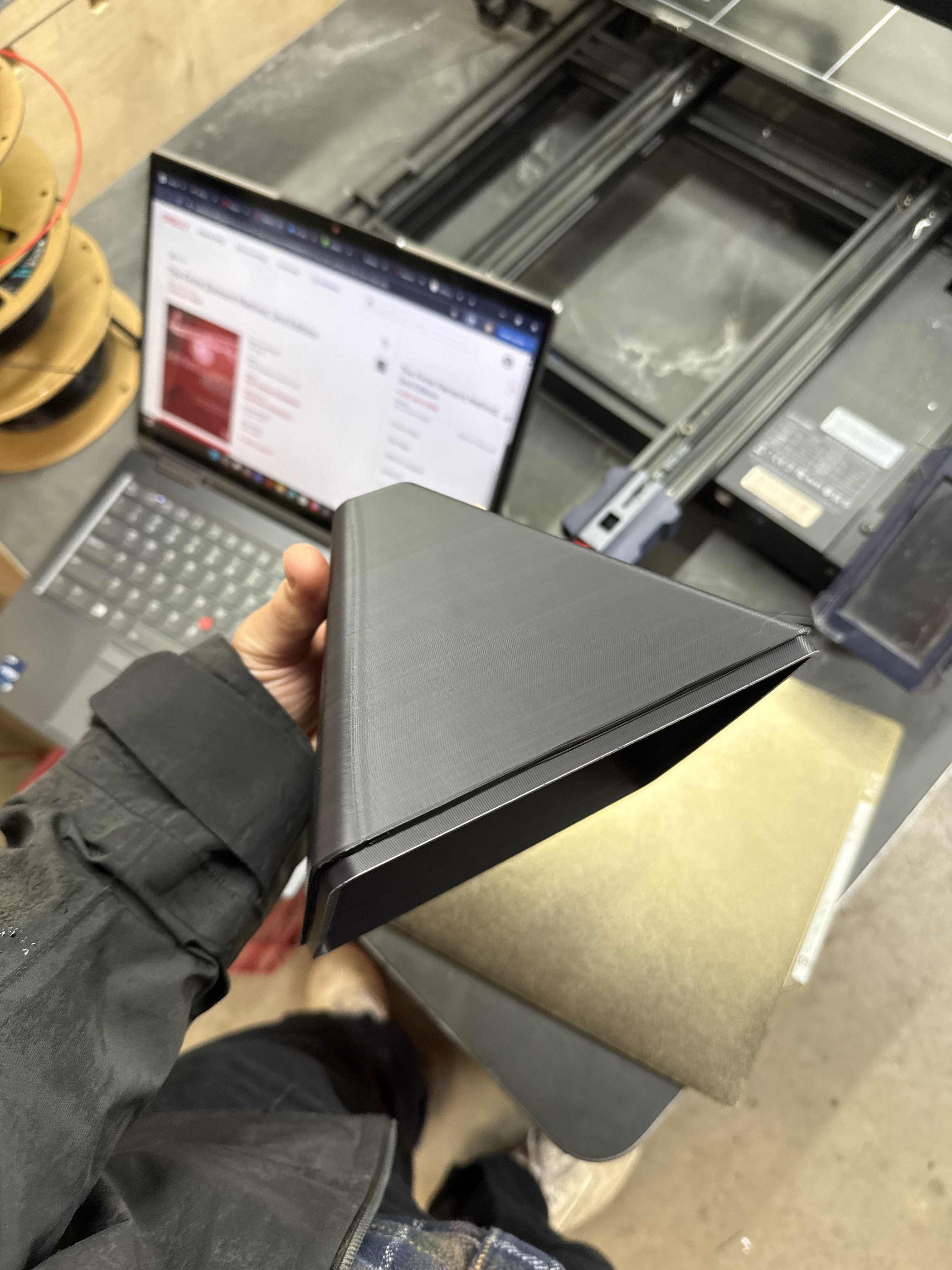
The completed prototype uses a 3D-printed ABS (Acrylonitrile Butadiene Styrene)
airframe wrapped around a carbon fiber spar skeleton, four outboard
BrotherHobby Tornado T5 motors driving 8×4.5 in three-blade propellers,
and a Holybro Pixhawk 6C flight controller running ArduPlane firmware. Wing-loading
analysis was hand-validated, the propulsion stack was bench-tested in SDSU's low-speed wind
tunnel, and the vehicle was flown across four field test sessions — including two
high-energy crashes and two successful ground-effect runs — before being shown at
SDSU Senior Design Day.
20.025 lb
Final Weight
4
Propeller Motors
28 lb
Total Static Thrust
42.7 mph
Peak Flight Speed
5.4 ft
Wingspan
7.42%
Static Margin
4
Flight Test Sessions
Pixhawk 6C
Flight Controller
The Team
SDSU Senior Design Day · May 6, 2026
The Barrelborne team with the completed vehicle
Luke Horton
Avionics Lead & Pilot
Maxwell O'Neill
Propulsion, Test & Integration Lead
Ethan Barichievich
Design & Manufacturing Lead
William Peterson
Performance & Data Analysis Lead
What Is Ground Effect?
Within 1 chord length
Lift increases
When a wing flies within roughly one chord length of the surface, the ground
physically blocks the downwash leaving the trailing edge. The result is a higher
effective angle of attack and a measurable bump in coefficient of lift (CL)
for the same pitch.
Within 1 wingspan
Induced drag drops
Inside one wingspan, the ground also disrupts the wingtip vortices that drive
induced drag. Cruise efficiency rises sharply — the same lift is held with
less power, which is why historical Soviet ekranoplans like the Caspian Sea Monster
could carry enormous payloads at high speed.
Real-world WIGs
Heritage
Barrelborne's design draws from the lineage of full-scale WIG vehicles — the
KM "Caspian Sea Monster" (USSR, 1966), the A-90 Orlyonok (1979), the Boeing
Pelican ULTRA concept, the AirFish 8, and modern entrants like REGENT's
Viceroy seaglider — scaled down to a 5.4 ft wingspan for academic flight
test.
Flight Test Footage
Four field-test sessions on the SDSU practice field. Two ended in successful
ground-effect runs; two ended in high-energy crashes that drove rebuild and design
changes — including a stiffer wingbox, a revised nose cone, and a center-of-gravity
(CG) shift to improve pitch stability. The clips below are the highlights.
✓ Ground Effect Flight Test 4
Best run: 42.7 mph, brief lift-off in ground effect
The cleanest flight of the program. Vehicle exceeded the 41 mph design takeoff
speed for the adjusted center of gravity, and attitude held within roughly ±1°
in pitch and roll before settling back to the surface.
✓ Ground Effect Flight Test
Clean low-altitude run
Vehicle accelerated cleanly along the field with stable attitude, demonstrating
controllable behavior in ground effect. One of seven runs recorded during the
final test session.
⚠ Crash — Flight Test 2
Wingbox & tail destroyed, no electrical damage
The first crash took out the wingbox, tail-fuselage section, vertical stabilizer,
nose cone, and wing section 4 — but the avionics survived intact. Drove
the wingbox stiffness and CG redesign that fed into Flight Test 3.
⚠ Crash — Flight Test 3
Rapid pitch-up at 16–17 m/s
Telemetry shows the vehicle reached approximately 38 mph cleanly, then pitched
up to roughly 70–80° nose-up around t=486 s with throttle cut shortly
after — consistent with an aerodynamic event rather than sustained pilot
input. Left wing and wingbox destroyed; avionics again survived.
Final Flight Test Results — Session 4
7
Runs in 1 Hour
42.7 mph
Peak Speed
±1°
Pitch & Roll Stability
Flight Test Day — Session 4
Crash Aftermath & Iteration
Two of the four flight test sessions ended in destructive crashes. Both events drove
real engineering changes — a stiffer wingbox, a redesigned nose cone, and a CG
shift — and in both cases the avionics stack survived intact, allowing the team to
reuse the Pixhawk, ESCs, and motors across rebuilds.
SDSU Senior Design Day
On May 6, 2026, Barrelborne was presented at SDSU's Senior Design Day — the
annual capstone showcase where graduating engineering seniors from every discipline present
their projects to industry judges, faculty, and the public.
Learn more about Design Day →
Booth #15 — College of Engineering
Showcased the completed airframe alongside the team's printed Senior Design Day
poster, telemetry data from Flight Test 4, and live demonstrations of the modular
motor-housing nacelle disconnect system.
The team walked judges and attendees through the build journey — from
airfoil trade studies through two crashes, two rebuilds, and a successful
ground-effect flight.
SDSU Senior Design Day Poster
Full project poster — objectives, design, build, flight test results · PDF
Explore the full aircraft and the modular motor-housing nacelle in your browser.
Drag to rotate, scroll to zoom.
Drag to rotate · Scroll to zoom · Right-click to pan
Drag to rotate · Scroll to zoom · Right-click to pan
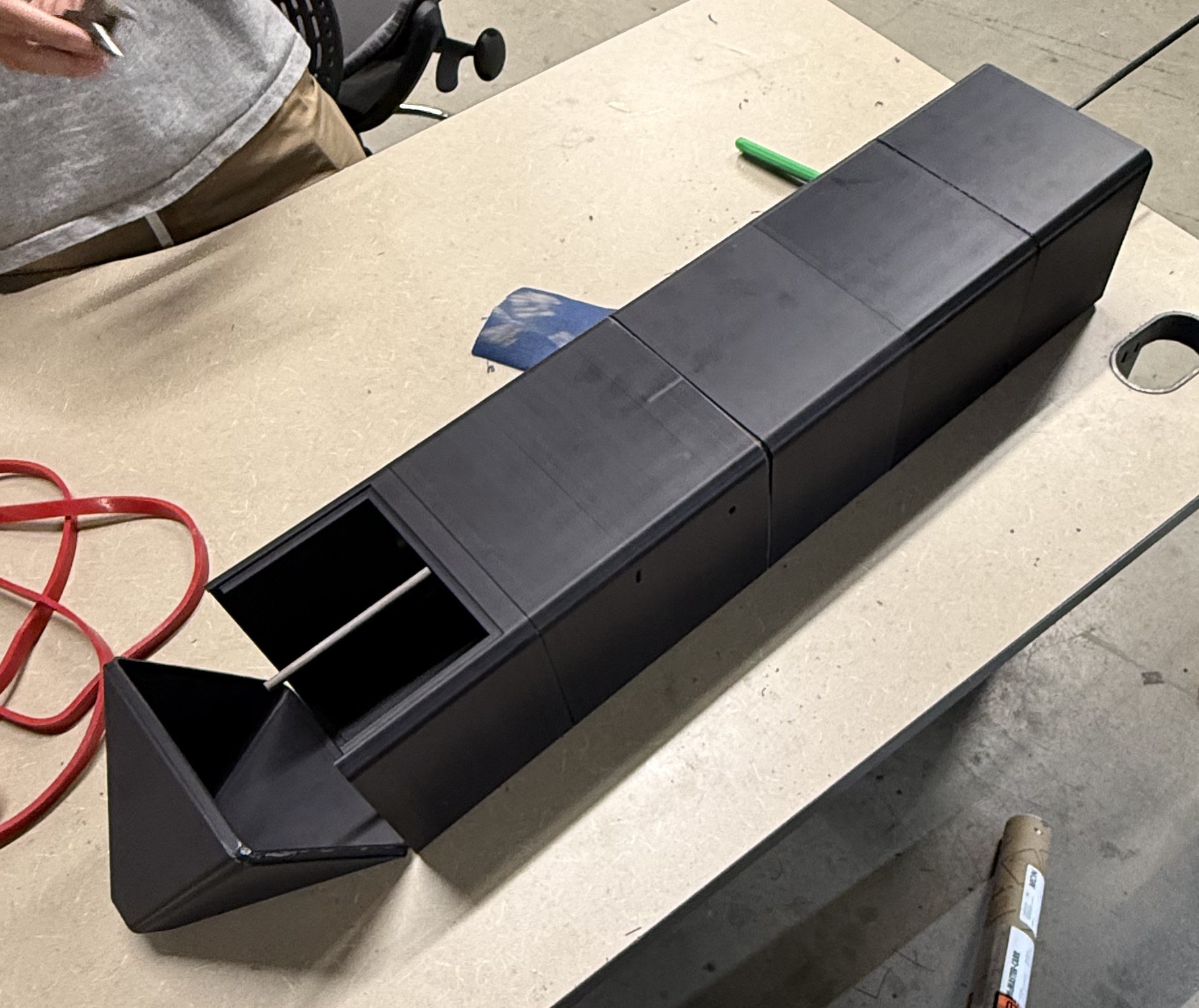
Motor Housing Assembly — The propulsion nacelle features a
tool-free magnetic coupling interface between each nacelle and the motor
housing structure, enabling rapid field removal and replacement without disturbing
surrounding components. The housing is built on a modular interlocking
architecture that registers directly into the wing box, allowing each nacelle
to be independently extracted, serviced, or reconfigured while maintaining full
structural continuity with the primary airframe.
Magnetic Quick-DisconnectTool-Free Field ServiceWing-Box IntegrationModular Nacelle ArchitectureIndependent Nacelle Removal
Manufacturing & 3D Printing
The entire airframe was 3D printed in-house on a Bambu Lab P2S using
Acrylonitrile Butadiene Styrene (ABS) plastic with 10% gyroid infill and a
two-wall-loop perimeter, then bonded to a carbon fiber spar skeleton. Total print time
across the fuselage, both wings, the tail, and four motor-housing nacelles was
270 hours. Buying the printer outright cut turnaround per part and
eliminated lab-printer queue delays during the build phase.
Overall Completion
100%
✓ Complete
Complete: 270 hrsRemaining: 0 hrs
270 of 270 estimated hours complete
Main Fuselage55 / 55 hrs (100%)
Wings (Left & Right)128 / 128 hrs (100%)
Tail Section55 / 55 hrs (100%)
Motor Housing32 / 32 hrs (100%)
Total Print Time: 270 hrs
Complete: All sections — Fuselage, Wings (L&R), Tail, Motor Housings (Nacelles 1–4)
Print Photos
Bench Testing
We tested the motors and propellers in SDSU's low-speed wind tunnel to measure maximum
static thrust. A custom aluminum mount was machined and fitted with a load cell to record
thrust output at varying throttle levels across all four motor and propeller combinations.
Bench testing validates performance before flight and helps catch mechanical or electrical
problems early, before the airframe is at risk.
We also completed all power system soldering: the four Skywalker V2 ESCs were soldered to
the Matek X Class 12S PDB (Power Distribution Board), along with the power module and the
UBEC (Universal Battery Eliminator Circuit) supplying regulated 5V power to the avionics
stack. Measured static max thrust across all four motors: 28 lb.
Wind Tunnel Testing
Soldering — ESCs, PDB, and Power Module
Build Story
A condensed chronology from research and trade studies in January 2026 through a fully
integrated, taxi-tested airframe in mid-April 2026.
April 13, 2026
Taxi Test
The fully assembled WIG vehicle completed its first taxi test. With all four motors running, the aircraft tracked straight on the ground and responded correctly to control inputs from the RadioMaster Boxer transmitter. Control surfaces and motor arming all checked out nominal. The airframe held up without issue under motor thrust loading.
April 9, 2026
Full Assembly & System Integration Test
Full airframe assembly completed. All electronics, wiring, servos, and avionics installed and integrated. Completed a full system test including motor arming, ESC (Electronic Speed Controller) calibration, control surface travel checks, and Pixhawk sensor validation. Flight controller configured in ArduPlane with telemetry link established.
Late March 2026
Motor Testing & Final Build Push
Motor and propeller bench testing completed in SDSU's low-speed wind tunnel. All wing sections, fuselage, tail, and motor-housing nacelles finished printing. Full assembly and wiring underway.
Early March 2026
Weeks 7–9: Full Build Phase Underway
To cut down on print times and eliminate dependence on shared lab printers, the team purchased a Bambu Lab P2S, dramatically reducing turnaround per part. Fuselage sections 1–4 and section 6 printed first; nose cone, section 5, wings, and tail followed. Wiring diagram finalized. Control surfaces designed, nose cone revised, and servo hatches completed.
Motors bench-tested in SDSU's wind tunnel — measuring thrust output, current draw, motor and ESC (Electronic Speed Controller) temperature, and checking for voltage sag under load. Pixhawk 6C, 3DR radio telemetry kit, and RadioMaster ELRS (ExpressLRS) receiver all received and installed.
February 23, 2026
Weeks 5–6: Parts Arrived, Printing Started
Motors, ESCs, batteries, propellers, carbon fiber spars, and all filament arrived.
Nose cone, fuselage sections 1–3, and wing section 1 completed on the printer.
February 6, 2026
Week 4: Design Finalized, Proposal Submitted
Design locked: FX 63-137 airfoil, aspect ratio 5.4, 5.4 ft wingspan, 4-motor distributed
propulsion. Full SolidWorks assembly completed. Proposal submitted and approved.
January 2026
Weeks 1–3: Research & Trade Studies
Researched historical WIG (Wing-In-Ground-Effect) vehicles — Caspian Sea Monster,
Lun class, Orlyonok, AirFish 8, REGENT Viceroy seaglider.
Completed airfoil trade study comparing FX 63-137, NACA 4412, and GAW-1.
Selected FX 63-137 for its superior low-speed high-lift characteristics.
Project Timeline
✓
Wks 1–4
Research & Design
Complete
✓
Wks 5–6
Procurement & Printing
Complete
✓
Wks 7–9
Build & Integration
Complete
✓
Wks 10–13
Flight Testing
4 sessions
✓
Wk 14
Final Report & Pres.
Submitted
★
May 6, 2026
Senior Design Day
Showcased
✓
Weeks 1–4
Research & Design
Airfoil trade study (FX 63-137 selected), wing-loading hand calcs, full SolidWorks assembly, design proposal approved
✓
Weeks 5–6
Procurement & Printing
Motors, ESCs, batteries, carbon fiber, and avionics received. Bambu Lab P2S printer purchased; nose cone and fuselage sections printed
✓
Weeks 7–9
Build & Integration
Full airframe assembly, ESC/PDB soldering, motor wind-tunnel bench tests, full system integration on Pixhawk 6C
✓
Weeks 10–13
Flight Testing
Four flight test sessions on the SDSU practice field — taxi tests, two crashes, two successful ground-effect runs, lift-off at 42.7 mph
✓
Week 14
Final Report & Presentation
Final report and capstone presentation delivered
★
May 6, 2026
SDSU Senior Design Day
Project showcased to industry judges, faculty, and visitors at SDSU's Senior Design Day capstone showcase